Queue Managers: The Complete Guide to Retractable Belts and Classic Rope Stanchions
A queue manager is the physical barrier system—composed of vertical stanchion posts, heavy weighted bases, and retractable belts or velvet ropes—used to direct foot traffic, prevent line-cutting, and secure restricted zones. Choosing the wrong hardware leads to crowded entrances, damaged marble floors, and safety liabilities.

Below is an engineering and operational breakdown of physical queue managers, including hardware selection, safety mechanics, spacing calculations, and commercial sourcing.
1. What is a Physical Queue Manager?
A physical queue manager (or stanchion) is a freestanding post designed to guide pedestrian traffic, organize waiting lines, and block unauthorized entry using connecting belts, ropes, or chains.
Every commercial-grade stanchion consists of four core parts:
The Post Tube: A stainless steel or mild steel pipe (typically 50mm to 63mm in diameter) with a wall thickness between 0.8mm and 1.2mm.
The Connection Head: Either a 4-way cassette containing a spring-loaded nylon belt or a 4-way collar ring that receives rope snap-hooks.
The Base Weight: A heavy plate made of cast iron, cement-filled plastic, or recycled rubber that lowers the post's center of gravity.
The Base Cover: A decorative steel cap matching the post finish, fitted with an underside rubber gasket to prevent floor damage.
2. Retractable Belts vs. Golden Rope Stanchions
Venues generally choose between two primary systems: practical retractable belt posts or decorative velvet rope stanchions.
[ Retractable Belt Post ]            [ Golden Rope Stanchion ]
       |=======| (Cassette)                 ( O ) (Crown/Ball Top)
       |   |   |                              |   |
       |   |   |                              |   |=== [Velvet Rope] ===
       |   |   |                              |   |
     .-'       '-.                          .-'       '-.
    (  Heavy Base )                        (  Heavy Base )
     '-----------'                          '-----------'
 Best for: High foot-traffic            Best for: Luxury hotels, VIP
 airports, banks, retail checkout       red carpets, museums, galas
Retractable Belt Stanchions (The Workhorse)
Retractable belt barriers feature an internal spring cassette holding 2 to 3 meters of tightly woven polyester webbing.
How they work: You pull the belt out of one post and slide its universal end-clip into the receiving slot of an adjacent post. The internal spring keeps the belt taut.
Primary advantage: Speed and flexibility. A single staff member can change a line from a straight corridor into a snake (switchback) pattern in seconds.
Best use cases: Airport check-in desks, metro ticketing gates, retail billing counters, and hospital registration areas.
Golden Rope Stanchions (The Aesthetic Standard)
Classic rope stanchions rely on polished metallic posts (typically gold, brass, or chrome) connected by velvet, velour, or twisted poly-hemp ropes.
How they work: Ropes come in fixed lengths (usually 1.5 meters) with spring-loaded snap-hooks or open hooks on both ends. These hooks clip into a 4-way ring collar welded beneath the post top.
Primary advantage: Visual elegance. They do not look like barricades; they suggest exclusive boundaries and guide guests politely.
Best use cases: Five-star hotel lobbies, red carpet gala entries, luxury retail displays, art museums, and VIP lounges.
3. Cost-Per-Meter Analysis: Which System is More Economical?
Looking only at the price per post gives an inaccurate picture of costs. You must calculate the cost per linear meter of queue line covered.
Because velvet ropes require a visual drape (sag), a 1.5-meter rope only covers about 1.2 meters of usable floor span. In contrast, a 3-meter retractable belt pulls out flat and covers roughly 2.8 meters of floor space without straining the internal spring.
| Metric | Retractable Belt Stanchion (3m Belt) | Golden Rope Stanchion (1.5m Rope) |
| Average Hardware Cost per Unit | ₹1,400 – ₹2,600 | ₹2,200 – ₹4,800 (Post + Rope) |
| Effective Usable Span per Post | 2.5 to 2.8 Meters | 1.2 to 1.3 Meters |
| Units Needed for a 15-Meter Line | 6 to 7 Posts | 12 to 13 Posts |
| Average Cost per Linear Meter | ₹600 – ₹950 / meter | ₹1,800 – ₹3,500 / meter |
| Daily Upkeep | Wipe clean with damp cloth | Metal polishing + rope vacuuming |
Takeaway: Retractable belt systems are roughly 60% to 70% cheaper per linear meter because they require half as many posts to cover the same distance.
4. The Stanchion Spacing Formula: How Many Posts Do You Need?
Facility managers often under-order or over-order queue posts. Use this standard formula to calculate the exact number of units required for any linear line:
Use $2.5\text{ meters}$ as the effective span for standard 3-meter retractable belt posts.
Use $1.25\text{ meters}$ as the effective span for standard 1.5-meter velvet rope posts.
Worked Example:
You need to set up a 25-meter queue line for an event.
For Retractable Belts:
$$\text{Posts} = \left(\frac{25}{2.5}\right) + 1 = 10 + 1 = 11\text{ posts}$$For Golden Velvet Ropes:
$$\text{Posts} = \left(\frac{25}{1.25}\right) + 1 = 20 + 1 = 21\text{ posts}$$
(Always add 1 extra post to cap off the end of the line).
5. Critical Hardware Specs That Prevent Accidents and Floor Damage
Cheaply built stanchions fail quickly under commercial use. Inspect these four build factors before buying in bulk:
+------------------------------------------------------------------------+
|                      CRITICAL QUALITY CHECKLIST                        |
+------------------------------------------------------------------------+
| [ ] Centrifugal Slow-Retract Brake (Prevents whiplash injuries)        |
| [ ] Minimum 6.5 kg Cast-Iron Base (Prevents tipping in crowds)         |
| [ ] Full-Circumference Rubber Gasket (Protects marble from rust rings) |
| [ ] True SS304 Stainless Steel (Resists corrosion from floor cleaning) |
+------------------------------------------------------------------------+
1. Centrifugal Slow-Retract Braking Mechanism
Budget belt stanchions use uncontrolled recoil springs. If a visitor accidentally unhooks an extended belt, the heavy plastic or zinc end-clip whips back at high speed, creating serious eye and hand injury risks. High-grade cassettes integrate a centrifugal brake that slows down belt retraction automatically when released.
2. Base Weight: Avoid Hollow Bases
A standard stanchion must withstand visitors leaning on it.
Lightweight bases (under 5 kg): Tip over easily when lines surge, bending the post pipe and risking guest injury.
Commercial-grade bases (6.5 kg to 9 kg): Use heavy cast-iron plates or dense composite weights. High-traffic transit points like metro stations often use 9 kg bases.
3. Full-Circumference Rubber Rim Protectors
Never place bare metal or unsealed concrete bases on polished stone, tile, or hardwood floors. Daily mopping traps water beneath the base, creating permanent rust rings. Ensure the base has an integrated, continuous rubber gasket around its bottom rim to buffer metal-on-floor contact.
4. Metal Quality: SS304 vs. SS202
SS202 Stainless Steel: Common in low-cost stanchions. It looks shiny initially, but acidic floor cleaners and humidity cause it to develop rust spots within 6 to 12 months.
SS304 Stainless Steel: Contains higher nickel content. It resists surface oxidation and maintains its finish for years, even in coastal areas or outdoors.
PVD Gold vs. Electroplating: For golden posts, choose PVD (Physical Vapor Deposition) Titanium Gold. Electroplated finishes peel and scratch easily around the snap rings, whereas PVD bonds directly with the steel.
6. The Modern Hybrid Queue: Connecting Physical Posts with QR Codes
A major operational mistake in customer flow management is treating digital ticketing and physical queue barriers as opposites.
When venues use only mobile apps or digital tokens, guests crowd randomly around doorways waiting for their numbers. When venues use only physical stanchions, customers get tired standing in long lines.
The industry-standard solution is the Hybrid Queue Model:
Physical Stanchion Grid: Set up retractable belt posts to define the exact path toward the counter.
Top-Mounted QR Sign Stands: Mount A4 or A3 acrylic sign frames directly onto the top threading of the entrance stanchions.
Digital Virtual Token: Customers walk up to the physical entrance, scan the QR code to take a virtual number, and then step into the organized stanchion corridor when their turn approaches.
This approach keeps waiting crowds organized while giving them real-time visibility into line progression.
7. Top Queue Manager Manufacturers and Sourcing in India
Delhi NCR is the central manufacturing and distribution hub for crowd control hardware in North India. Sourcing locally from established Indian producers ensures quick access to replacement belt cassettes, custom logo webbing, and verified metal gauges.
Here are the top five dedicated manufacturers and enterprise suppliers in the Indian market:
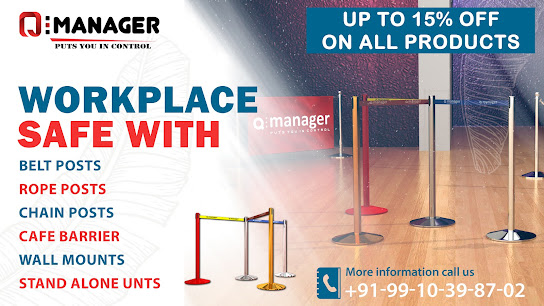
Q-Manager® / I.Q. Enterprises (India) Pvt. Ltd. (Delhi / Parwanoo): Established in 2004 with an indigenous manufacturing facility. They are the market leaders for domestic corporate contracts, supplying both belt and classic rope systems across India and abroad.
Tensator India (Pan-India): The global pioneer that originally invented the retractable webbing barrier. They provide military-grade webbing cassettes with patented slow-retract brakes, making them the primary choice for international airports and high-security zones.
7M QManager (New Delhi): Offers scalable pricing tiers ranging from economical post ranges to premium double-belt systems designed to prevent children from slipping under queue lines.
SAFEX INC (New Delhi): An established manufacturer and exporter focusing on heavy-duty crowd-control barricades, custom powder-coated finishes, and tear-resistant nylon belts.
Honesty Group (Delhi / Lucknow): Known for carrying extended 2.75m to 3m belt cassettes and offering fast in-house screen-printing for corporate logos on barrier webbing.
For turnkey B2B procurement, regional enterprises like Yogesh Enterprises also supply commercial crowd-control hardware and stanchion systems, giving commercial buyers direct access to clear side-by-side product comparisons and reliable local logistics.
Frequently Asked Questions
How heavy should a commercial stanchion base be?
For indoor retail and banking, a base should weigh at least 6.5 kg to 7.5 kg. For high-density public venues like transit terminals and exhibition grounds, select bases weighing between 8.5 kg and 10 kg to prevent tipping during crowd surges.
Can retractable belt stanchions be used outdoors?
Yes, provided the posts are either marine-grade SS304 stainless steel or weather-treated with outdoor thermoset powder coating. Standard chrome or SS202 posts will pit and rust if left exposed to rain.
What should you do if a stanchion belt stops retracting?
You do not need to replace the entire post. Top manufacturers build their units with modular cassette heads. Unscrew the top cap or remove the mounting screws, pull out the worn cassette, and slide in a new replacement spring cartridge.
What is a double-belt stanchion?
A double-belt stanchion features two horizontal belts mounted on a single post: one at standard waist height (around 900mm) and a second lower belt (around 450mm). This configuration complies with international accessibility guidelines and stops children and luggage carts from rolling underneath the line.
.png)
Comments
Post a Comment